
Our Books
Playbook for Digital Transformation
This book takes us through the story of John on how he came to terms with the fast pace of changes happening around him, mastered the skills to navigate them, and to finally lead these changes, taking his team along on the ride.
AI revolution is making this story relatable to us all. We all want to be on the train to the future, rather than being rudely asked to get off it. Our future depends on us learning these lessons by heart.
From Legacy to Leading Edge: A Leadership Blueprint of Digital and Business Transformation is not a traditional business book. It is a step-by-step approach to orchestrate complex initiatives across departments, align diverse teams toward a common vision, and embed adaptability into the very DNA of our teams and organizations.
In this book, the author, Shahab Najmi, offers a clear, actionable framework grounded in five core pillars: strategy, governance, people, process, and technology. Drawing on best practices from project management, agile methodologies, leadership theory, and management consulting, this blueprint helps you break down silos, foster collaboration, and implement business transformation that sticks.
Simple to read but rich in applicable ideas, this book will change your approach to life, management, and organizational politics!
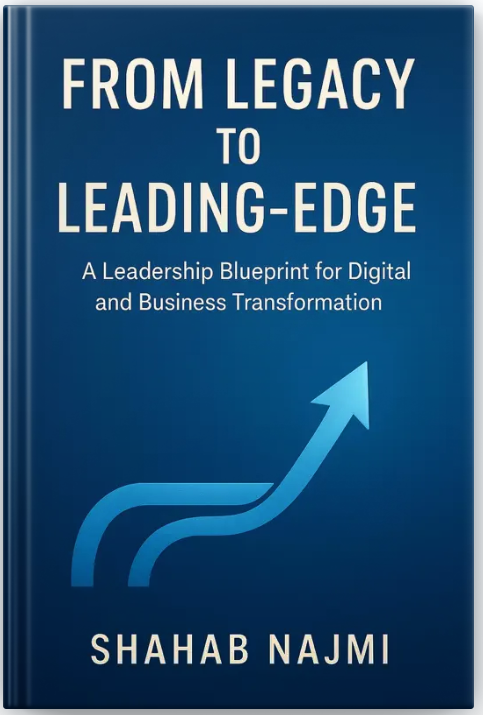
Organisational transformation framework
The book uses a fictional format to explain our organisational transformation framework.
Read excerpts from the book below.
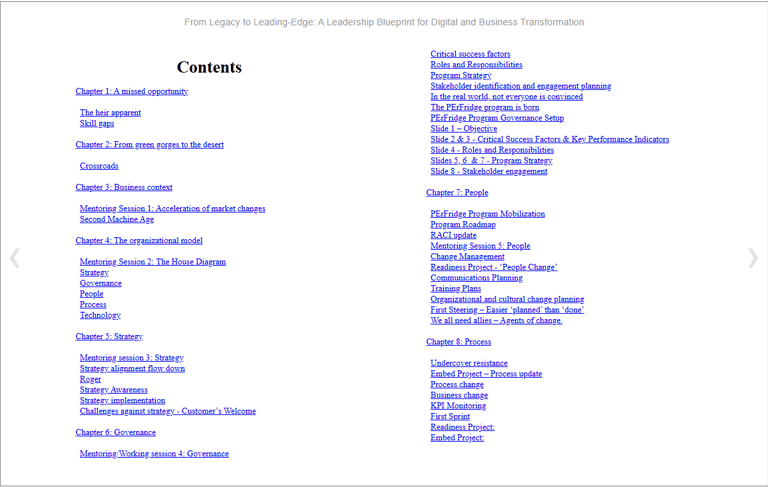
Sample from the book
The heir apparent
John Black, in his late forties, had done well in the workplace and delivered for his organization, DataTech Corp, which was a leading Information Technology (IT) System Integrator based in Riyadh, Saudi Arabia. John felt that he was now a veteran in this organization and had progressed to the position of 'Senior Program Manager' for a large and important customer, a conglomerate called Falconridge Group. He was widely anticipated to be promoted to the 'Account Director' role, managing projects as well as the service delivery organization based on his previous successes in the project delivery area. He was respected, if not always liked, and had a solid relationship with the customer’s management team.
When he applied for the Account Director position, John did not see too many rivals within the organization. However, he did expect competition from outside candidates as DataTech Corp was a regional leader, and the position was a coveted one in the industry. Still, John was confident in his chances since the organizational policy gave preference to internal candidates who were qualified for key organizational roles.
John awaited the announcement patiently for several weeks, but it was not forthcoming. Around a month after his application, he was called into a meeting with the current Falconridge Account Director, who was his Line Manager, and the company’s Deputy COO. He had anticipated this to be his crowning moment, but as he entered the Director's office, the mood was somber. John began to feel uneasy. Mohammed, the retiring Account Director, asked him to sit down. The Deputy COO, Martin, was distracted by a phone call.
Martin hung up and turned to face John. "John, although you were a strong candidate, I am afraid you were not selected for the Account Director role," said Martin, rather coldheartedly. John was baffled. He was lost for words and couldn’t think clearly. How could this have happened? He uttered, "Who ...?".
"We have selected Roger to be the new Account Director. This shall be announced tomorrow." Martin replied simply. John was shocked at hearing this, Roger had joined the organization less than two years ago. While he was generally considered a high performer, John had not even been aware that he was a serious candidate because of his young age and lack of experience in both projects and services, which were part of the requirements for this prestigious role.
"Thank you.", said John, and he left the room without further comment. He was disillusioned by all this and felt like throwing in the towel there and then. "This is so unfair", he thought, "what else could I have done to get this promotion?" Presently, he didn’t feel like being there, so he left the building in a state of disbelief.
John returned to his car and drove to his favorite coffee shop to help him think. He ordered his usual Latte without thinking and began sipping it absentmindedly. After some minutes, he started to get some clarity. Yes, Roger was young and less experienced, but he was well regarded within the organization. John knew Roger well, as he was part of the IT Service Delivery team and used to interact with him regularly. He always seemed to know what he was talking about, was well-liked by all, and, perhaps most importantly, he was highly organized. He was known to be hard-working but not overly so. He was always the person people went to solve their problems. Despite all this, John could not believe the apparent injustice of the situation. "I have worked day and night for this organization for the last 15 years!"
John mentally acknowledged, albeit grudgingly, that Roger would be a decent choice for this role, but he could not bring himself to think of any one characteristic that made Roger a better choice. He was less furious now, yet the question was still open in his mind - what made Roger deserve the promotion more than he did? He was still convinced that it was not a fair choice and contemplated all possible reasons for it - golf buddies, personal relationship with any of the management team, nepotism - though nothing seemed obvious.